
written by Capt Jordan Hempker
As fire departments establish operational standards, tactics and strategy, policies and procedures, equipment specifications—we naturally grow comfortable with the systems in place. Over time, we often forget the process that led us to those decisions in the first place.
When we forget the process, the system drifts into autopilot. Weeks turn into months. Months turn into years. Eventually, it can evolve into the dreaded phrase: “That’s how we’ve always done it.”
Organizations that recognize the need to revisit and, when necessary, revamp their systems foster a culture of growth and development. They create opportunities to improve equipment and the support systems surrounding it. More importantly, they encourage member buy-in. When firefighters feel they are part of the evaluation process—or able to contribute subject matter expertise—they invest in the outcome.
When should departments reevaluate their attack packages & pump discharge pressures?
In this article, we will focus specifically on the need to reevaluate one of the most critical systems an organization builds: its hose and nozzle attack package. Too often, departments select a hose and nozzle configuration, flow it once to obtain pump discharge pressures, commit those numbers to memory, and never revisit the training for years—if ever.
We will outline three trigger categories that should prompt departments to test, verify, and educate their members on their hose and nozzle attack packages.
It matters to know exactly what we are doing as the engine company arriving on scene. The first line makes the difference.
Trigger #1: When you get new hose
Fire departments experience change on a daily basis. Changes occur within the run district as new construction appears or buildings are remodeled. Response models evolve. EMS protocols are updated. When these changes occur, departments communicate clearly, educate their members, and prepare the organization to operate successfully within the new system.
However, changes to hose and nozzle packages are not nearly as common.
Through travel, training, and conducting hose demonstrations, I have met many fire departments that still operate with legacy attack lines that have been in service for more than twenty years. When asked about the hose package, the common response from senior members is simple:
“It’s been on the truck since I’ve been here.”
Many of these legacy systems were designed around high-pressure hose paired with 100 psi nozzles, flowing somewhere between 125–180 GPM on a 1¾” line with a pump pressure range of 130 psi to 150 psi and 250–300 GPM on a 2½” line with a pump pressure range of 120 psi to 140 psi. These packages worked for decades. They were refined by experienced firefighters and proved themselves on countless firegrounds. Because they continued to put fires out, the system was rarely questioned or reevaluated.
Today, however, many departments are replacing equipment more frequently. Grants have become more accessible, firefighters are seeking out new training opportunities, and many departments maintain strong working relationships with vendors and manufacturers. As a result, hose replacement projects are becoming more common.
Unfortunately, the process often looks like this: the new hose arrives, it is laid out on the apparatus bay floor, and the unfortunate shift on duty is tasked with loading the entire order onto the apparatus.
Without ever testing it.
Whenever new hose is purchased, it must be tested, verified, and evaluated.
Modern hose construction has changed significantly over the years. Manufacturers now offer lighter outer jackets, different liner materials, and slight variations in internal diameter designed to support specific flow targets. Many modern hose lines are engineered to achieve higher flows with lower operating pressures.
A common mistake departments make is assuming that all fire hose is essentially the same. It is not. In fact, small differences in hose construction—particularly internal diameter—can dramatically change how an attack line performs.
Fire departments also make the mistake of mixing legacy hose with newly purchased hose without understanding the hazards that may be created. An attack line may end up consisting of several sections of hose with completely different operating characteristics. Variations in internal diameter can create turbulent water movement within the line and may increase the likelihood of kinking at different points in the stretch.
A common example is found when departments operate a 200-foot attack line by leading the first 150 feet with new hose and placing the older legacy hose at the nozzle end. That legacy hose was designed to operate with a 100 psi nozzle and higher pump pressures, and it will often perform poorly for the nozzle firefighter even though quality hose is feeding into it.
If departments must temporarily mix hose due to budget constraints, it is recommended that the older hose be placed toward the back half of the attack line with the newer hose positioned closer to the nozzle. This configuration allows the section of hose that directly influences nozzle performance to have the best operating characteristics. While not ideal, it can serve as a temporary solution until the entire hose fleet can be replaced.
Departments transitioning from traditional high-pressure hose to modern low-pressure hose must understand the differences in construction and performance. Legacy hose systems required higher pump pressures not only to operate the 100 psi nozzle but also to provide stiffness in the hose line. The higher pressure created the rigidity needed to prevent kinks and control nozzle reaction.
Low-pressure hose systems are built differently.
Today, with modern hose construction, we are seeing 1.75” attack lines providing flow rates of 150 to 185 GPM at pump pressures ranging from 90 psi to 120 psi. The 2.5” attack line is capable of providing flows ranging from 150 GPM to 324 GPM with pump pressures ranging from 70 psi to 110 psi. The difference lies in the lower nozzle operating pressure, hose construction designed to support the system, and the supplemental testing departments conduct to account for the specific plumbing of their pumping apparatus.
These hoses are designed to maintain structural integrity at lower operating pressures. When paired with 50 psi nozzles, the system can deliver higher flows with significantly reduced pump pressures. If a department simply applies its previous pump charts and operating pressures to a completely new hose package, the result can be a dangerously over-pumped line.
Over-pumping increases nozzle reaction, increases flow beyond the intended design, and reduces the efficiency and maneuverability of the engine company.
In many cases, this ultimately leads to the most dangerous condition of all: A closed nozzle.
Whenever a department introduces new hose into service, the entire attack package must be evaluated from the pump to the nozzle. Inline pressure gauges, pitot gauges for smooth bore nozzles, and flow meters can help crews collect accurate data and confirm true nozzle pressures and flows.
Departments may discover that friction loss has decreased due to slight variations in fire hose internal diameters. Pump discharge pressures may be lower than expected. In many cases, the engine company may find that the apparatus can operate more efficiently, placing less strain on the pump while still delivering effective fire flows.
New fire hose should not simply replace the old system—it should trigger evaluation of the entire attack package.
When approached correctly, it becomes an opportunity to refine operations and develop a system that best supports the department’s staffing, apparatus, and run district.
Trigger #2: When You Get New Firefighters
When a fire department hires new firefighters, an exciting and critical process begins: building the next engine company member.
That process looks different for every organization depending on size, call volume, and staffing model. But one constant remains—the responsibility ultimately falls on the company officer to set the standard and define expectations within their engine company culture.
It is no secret in the fire service that the company officer is the most influential position in the department. I would like to share an approach that has proven successful in my role as a shift Captain (Shift Commander), one that I have passed on to my Lieutenant (Engine Officer) and has now become our shift standard for training rookies.
Engine Day: Crawl. Walk. Run.
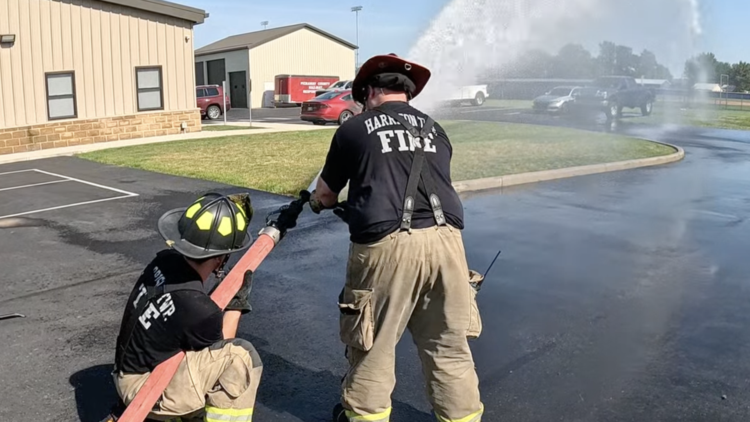
One of the first dedicated training days a new shift member receives is “Engine Day.” This initial exposure to engine operations follows a crawl, walk, run model.
Crawl Phase: Discussion and Detail
We begin with deliberate discussion. As a full shift, officers lead a detailed breakdown of each attack line: hose loads, nozzle selection, target flow, pump discharge pressures, and operational expectations.
This is intentional. Having all skill and leadership levels present ensures consistency in standards. It reinforces expectations not only for the rookie but for the entire crew.
The rookie then pulls each line multiple times at a slow, controlled pace. The focus is on understanding the details of the hose load—not speed. As confidence builds, complexity increases.
As repetition improves performance, officers begin to step back. Senior firefighters and Acting Officers start taking the lead. As Captain, I listen closely, vet the information being shared, and confirm that standards are being upheld.
Having worked through the ranks, I firmly believe a Shift Commander must understand exactly what the line firefighter is experiencing on the hoseline. When assignments are given from the command post, they should be grounded in real operational understanding—not theory.
Walk Phase: Flowing Water in a “Perfect World”
Once hose deployment reaches a competent level, we shift to flowing water.
At this point, most rookies are experiencing information overload. The key is simplicity.
We stretch various lines—1¾”, 2¼”, and 2½”—into a perfectly straight layout. No kinks. No obstacles. A controlled environment.
Each line is charged and brought to the proper pressure and verified flow. Nozzle work is broken down in detail. I keep a copy of our pump chart visible so the rookie can connect what the pump operator is doing at the panel with what they are feeling at the nozzle.
This “perfect world” setup allows the rookie to see, feel, and handle a properly pumped attack line.
We are building a mental Rolodex.
They must know what a good line feels like before they can recognize a bad one.
Run Phase: Introducing Imperfection
Once that baseline is established, we introduce variables.
We add kinks. We change layouts. We create more realistic stretches. The rookie begins to feel changes in stream quality, nozzle reaction, and hose handling.
Simultaneously, the pump operator experiences gauge fluctuations, audible changes in pump performance, and opportunities to practice problem-solving.
We then intentionally over-pump and under-pump lines.
The rookie must feel the difference.
They must see the stream quality change.
They must identify inadequacy.
This is where critical thinking develops.
If a nozzle firefighter experiences a deficient attack line, they must know how to:
Chase a kink
Communicate effectively by radio
Request a pressure adjustment
Diagnose the issue under stress
If both the pump operator and nozzle firefighter can problem-solve together, they will identify deficiencies quickly and apply effective water to the fire.
Why This Matters
These trainings start slowly but evolve into full-scale drills and scenario-based evolutions. Over time, they produce efficient crews.
When officers teach and senior members reinforce the standard, the culture becomes transferable. The rookie eventually becomes the senior firefighter who trains the next new member.
And that is the point.
Bringing on new firefighters is not just about orientation—it is a trigger to reevaluate and reaffirm your hose and nozzle system. If you cannot clearly explain, demonstrate, and validate your attack package to a new firefighter, then it is time to revisit it.
Because the first line still makes the difference.
Trigger #3: When Something Feels Wrong
When an engine company is truly dialed in—pressure, flow, feel, and maneuverability—the handline becomes second nature. That is the mark of a well-designed system and in-tune firefighters.
Because the system is familiar, abnormalities stand out immediately.
I often compare it to your personal vehicle. You drive it every day. The moment you feel a vibration or hear a new noise, you notice it. You may not know the exact cause yet—but you know something isn’t right.
The same applies to our apparatus and hose systems.
When something feels off, red flags should immediately go up.
Common indicators include:
The line feels uncontrollable — is it over-pumped or under-pumped?
Stream quality is poor — is there an internal hose issue or nozzle damage?
Excessive vibration at the nozzle
Increased noise while flowing
Pump sounds or vibrations that seem abnormal
Gauges that don’t match expected pressures
Increased workload at the pump panel
Equipment swapped from a reserve engine
Recent extreme weather that could have damaged components
Suspected hose delamination from previous fires
When these signs appear, it is the crew’s responsibility to begin systematic troubleshooting.
Sometimes the solution is simple.
Sometimes it requires taking equipment out of service.
Sometimes it’s the call: “Chief, can you come take a look at this?”
But it always begins with recognizing the abnormality.
Start With the Baseline
This is where your pump chart becomes invaluable.
Your pump chart represents your baseline—verified pressures, flows, and performance expectations. When something feels wrong, shut it down and start over.
Flow the line according to the chart.
If discrepancies appear, begin narrowing the cause:
Hose issue?
Nozzle issue?
Apparatus problem?
Gauge malfunction?
User error?
Guessing is not troubleshooting. Data is.
Use Simple Diagnostic Tools
Some of the most effective troubleshooting tools are:
Inline pressure gauges
Pitot gauge (for smooth bore nozzles)
Flow meter
A strong diagnostic setup includes:
One gauge at the discharge
One inline gauge approximately 100 feet down the line
A pitot at the nozzle (if smooth bore)
Now you have multiple data points.
You can verify:
Pump gauge accuracy
Friction loss in the hose
True nozzle pressure
Actual gallons per minute
For example, if an attack line is designed to flow 160 GPM with a 7/8” tip, but your flow meter shows higher output, you may have an unintended valve open—such as tank fill—or an internal valve issue. These devices eliminate guesswork.
A Real-World Example: The Over-Pumped 2½”
During one of our rookie “Engine Day” trainings, we moved to our 2½” attack line:
200 ft
Smooth bore nozzle
Stacked tips: 1 1/8” and 1 1/4”
- Designed flows:
265 GPM (1 1/8”) at 80 psi PDP (50 psi NP)
324 GPM (1 1/4”) at 90 psi PDP (50 psi NP)
We were flowing a single line.
Immediately, something felt wrong.
The nozzle firefighter struggled with control. At first, I attributed it to the fact that this was a newer member. But experienced firefighters had the same difficulty.
The stream quality was poor:
Reduced reach
Early stream break-up
Excessive nozzle noise
The line did not perform the way it had during previous trainings.
We checked the nozzle pressure with a pitot gauge.
It read 60–64 psi.
Grossly over-pumped.
We shut everything down and went back to the pump chart. Following our chart and adjusting pressure while monitoring the pitot, we determined that the nozzle returned to 50 psi when the individual discharge gauge read 65 psi—not 80 psi as the chart indicated.
The issue?
A faulty discharge gauge.
Here’s what was happening:
The master discharge gauge was set correctly at 80 psi.
The individual 2½” discharge gauge falsely displayed 65 psi.
Pump operators increased pressure until that gauge read 80 psi.
In reality, the line was being significantly over-pumped.
When flowing multiple lines, the problem became even more dangerous. With the master discharge at 110 psi for a 1¾” line, the 2½” had to be gated down—but because the gauge was inaccurate, it continued to be over-pumped.
We identified a situation where a large-caliber handline could have:
Injured firefighters
Reduced stream effectiveness
Created a false sense of proper pump operation
We notified the chiefs immediately, and all pump panel gauges were replaced.
Why This Trigger Matters
The fire service places enormous strain on equipment.
Engines go from cold bay status to high-demand pumping within minutes. Lines are deployed aggressively. Water is introduced rapidly. Pumps operate at peak performance without warm-up.
Over time, components fail.
If your crew is not in tune with how a properly functioning attack line should feel, you may never catch those failures.
When something feels wrong, it probably is.
That moment is not an inconvenience—it is a trigger.
A trigger to:
Shut down
Verify
Diagnose
Correct
Final Thoughts
Hose and nozzle packages are not “set it and forget it” systems.
They are high-demand operational tools that must perform under extreme conditions. Components wear. Gauges fail. Hose degrades. Nozzles change. Apparatus gets modified. Personnel turns over.
It is not enough to flow a line once, write down a pressure, and never revisit it.
It’s critical to test your systems over time and verify your numbers to ensure your pump panel is accurate and your attack lines are delivering what you believe they are.
Without verification, you’re operating on assumption.
With verification, you’re operating with confidence.
Flow it. Measure it. Validate it.
Because the first line makes the difference