
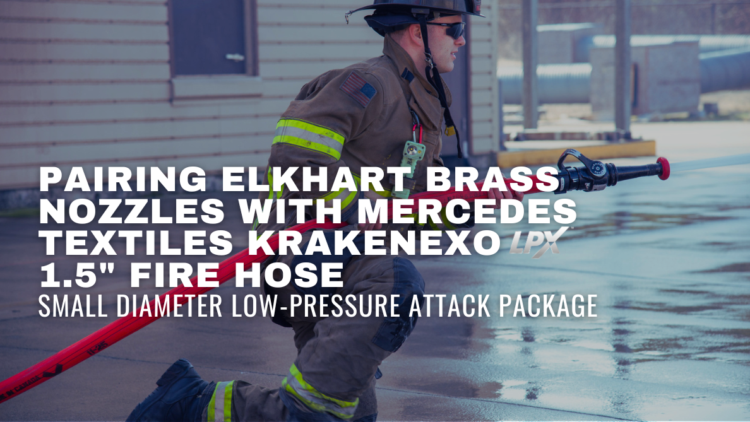
For years, firefighters have debated the balance between flow, maneuverability, and control when it comes to small-diameter attack lines.
The challenge wasn’t whether a 1.5" hose could flow enough water – our KrakenEXO inner diameter certainly could handle the flow with reasonable friction loss. The real challenge was stability. Could firefighters actually control and advance the line effectively?
As flows climbed into the 150–160 GPM range and pressures dropped between 50-75 psi, most traditional 1.5" hose packages became increasingly difficult to manage. When the nozzle reaction goes up, the smaller column of water can’t support it – particularly with lighter, more flexible materials. The line handling demands of interior attack pushed crews toward larger diameter hose simply to gain better control.
LPX™ Technology was engineered to change that
Integrated into the KrakenEXO® LPX 1.5" and ExoMetro® LPX 1.75", LPX™ Technology reinforces only the working length nearest the nozzleman — the area where firefighters need the most stability during aggressive interior operations.
By strengthening only that section of the hose, Mercedes Textiles maintained the lightweight, highly packable, and maneuverable characteristics firefighters expect while dramatically improving control at modern low-pressure, high-flow configurations.
But the hose is only half of the equation when building an effective small diameter, low-pressure attack package. The nozzle is equally important. The right pairing is where the performance shines.
NOZZLE PAIRING with LPX™ Technology
Different nozzle manufacturers offer different approaches to balancing flow, pressure, nozzle reaction, and line performance. Whether departments prefer smooth bore configurations, low-pressure combination nozzles, or integrated back-pressure technologies, each setup creates its own advantages and operational considerations.
In this series, we’re breaking down some of the LPX nozzle options from Elkhart Brass, HEN Nozzles, and Task Force Tips (TFT).
Each pairing offers a slightly different approach to achieving the same goal: Deliver effective attack flows through a lightweight, maneuverable package, minimizing firefighter fatigue without sacrificing control on the fireground.