
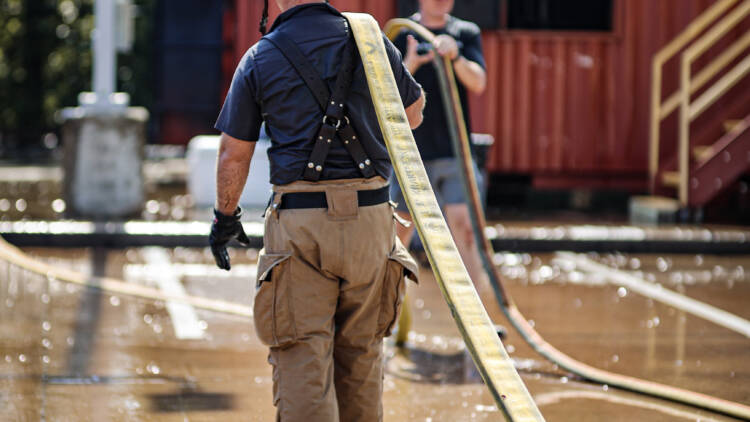
Fire hose longevity isn’t luck. It’s maintenance, awareness, and a bit of discipline. Whether your department is working with first-line attack hose or wildland forestry lines, every inch of your equipment tells a story — and how well that story ends depends on how well you take care of it. Even the toughest builds need smart care to deliver years of reliable service.
Here’s how to make sure your hose lasts as long (and works as hard) as it should.
1. Clean and Dry: The Basics of Hose Longevity
After every use, rinse the hose thoroughly to remove dirt, ash, and chemical residue. Contaminants not only wear on the jacket and liner but can also degrade materials over time.
A hose washer can make quick work of cleaning hose, but scrubbing gently using a soft bristle brush & soapy water works just as well. We don’t recommend using a pressure-washer, as it can wear out the jacket integrity if used too closely. If you do use one, be sure to keep the spray more than 10” away.
Even though fire hose is treated with a protective coating, a basic clean and full dry cycle before storage prevents mildew and mold growth — small steps that can add years to the life of a line. When possible, hang the hose to dry or use a low-heat dryer. Stacked storage with moisture trapped inside is one of the fastest ways to shorten service life.
2. Check It Like You Mean It
“Checking” a hose isn’t just a box on a maintenance log.
It’s your opportunity to find issues before they find you. A good inspection means looking and feeling — because many small jacket or coupling issues show up first as texture changes or stiffness, not visible damage.
Here’s what a proper inspection should include:
Visual: Look for cuts, abrasions, chemical damage, or unusual wear patterns. Also notice any leaks when charged.
Tactile: Run your hands along the line to feel for bubbles, rips, or other damage to the jacket.
Couplings: Check for corrosion, loose expansion rings, and damaged threads.
Pressure test: Follow NFPA 1962 or your department’s testing protocols annually to confirm performance integrity. You can access the full NFPA 1962 standard online here.
Hose failure doesn’t usually start at the moment it bursts — it often starts with something small that could have been caught during a post-job inspection. Take the time to check the line every time.
3. Store Smart
The way your hose rests between calls matters a lot. Store it in a cool, dry place, away from direct sunlight and petroleum products. When re-racking, avoid tight bends and creases that can fatigue the inner liner over time. Rotating hose sections and re-racking after use helps distribute wear evenly across the entire length.
4. Invest in Materials That Work as Hard as You Do
Aging hose is inevitable. Premature failure isn’t. The difference often comes down to build quality and material science. That’s why Mercedes Textiles engineers every hose with performance longevity in mind – and we back it up with our 2-10-L warranty.
Our inner lining Mertex is bonded for durability (never delaminates!) and minimal friction loss, helping maintain flow characteristics year after year.
Our outer jacket starts with quality heavy-duty yarn, woven tight to add rugged strength while maintaining flexibility.
Our protective coating Permatek not only colors the hose, but also are treated for superior abrasion resistance and chemical stability.
Our design philosophy focuses on lightweight handling without sacrificing structural integrity, which reduces fatigue and extends service life across deployments.
When you start with a hose that’s designed to last, every inspection, cleaning, and test extends a product already built for endurance.
5. Replace Before It Fails
Even with excellent maintenance, all hose has a service life. If a section shows soft spots, consistent leaks under pressure, or excessive jacket wear, retire it early. A small replacement cost today beats a catastrophic failure tomorrow.
If you’re unsure what your next replacement cycle should look like, our team can help evaluate your needs and suggest hose lines optimized for your operating conditions — from municipal supply and attack to forestry hose.
Your hose is your lifeline. Extending its life isn’t about avoiding replacement; it’s about ensuring every length performs safely and predictably when it matters most.
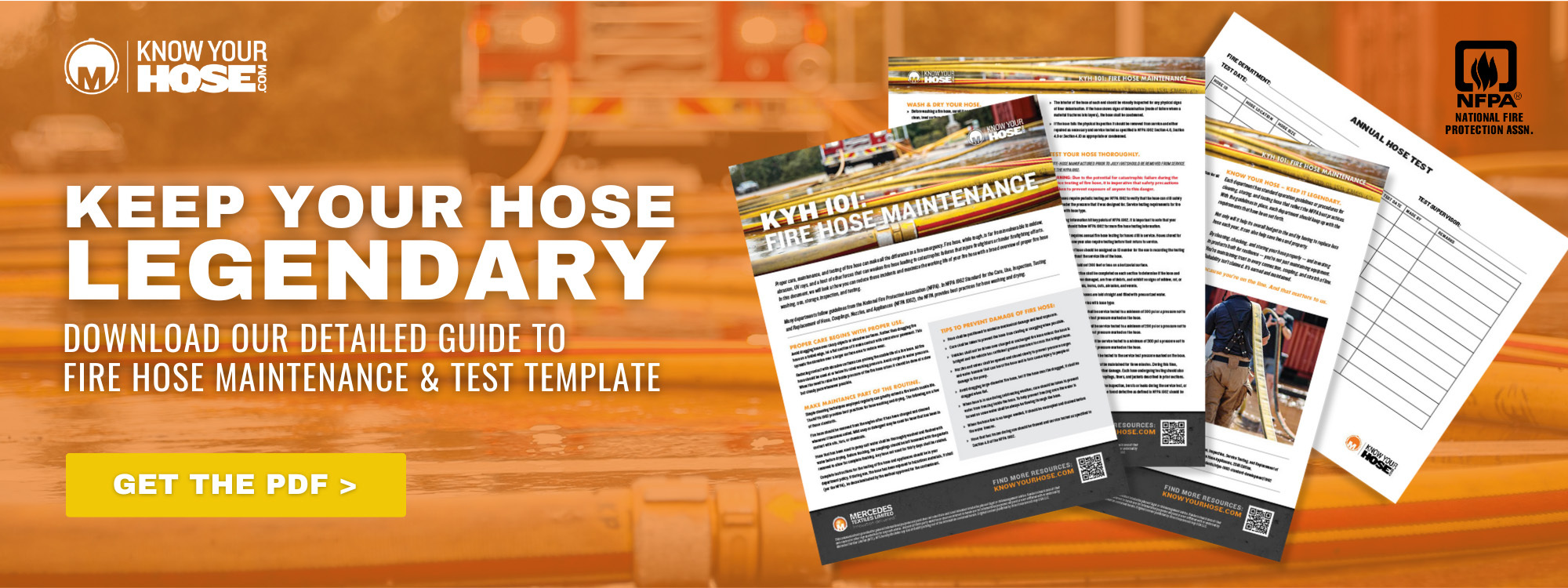
DOWNLOAD THE FIRE HOSE MAINTENANCE GUIDE PDF
KNOW YOUR HOSE; KEEP IT LEGENDARY
By cleaning, checking, and storing your hose properly — and investing in products built for resilience — you’re not just maintaining equipment. You’re maintaining trust in every connection, coupling, and stretch of line. Because reliability isn’t claimed. It’s earned — and maintained.
Explore the full Mercedes Textiles lineup — engineered for performance, longevity, and the confidence that every line you deploy is ready to move when you are. Learn more about hose care, NFPA testing, and material durability here on KnowYourHose.com.
QUICK FIRE HOSE CLEANING GUIDE
All hose lines should be cleaned after each job – or at minimum, after each active shift.
Common soap (dish soap) solutions can be used, as well as sodium phosphate.
Warm water works best, but water temps over 200F are not recommended.
Do not soak it in turpentine, strong alcohols, high bleach cleaners (over 3%
concentration), or other aggressive solvents, as this may affect the liner or coating.
If brushing, use a soft-bristle nylon or similar plastic type brush to lightly scrub the hose jacket to remove stubborn dirt.
Do not use close-range pressure washer type spraying pumps, as the water from the spray can penetrate the lining material.
Thoroughly rinse off the hose with water and let dry before storing or repacking.
HOSE DRYING
Hanging the hose vertically works well for drying. Ensure each line has room for air movement and the couplings are not blocking drainage.
Some electric dryers are automatic and shut off when the humidity is at a certain level. If not, the hose should not be left for more than 8 hrs without checking it.
The temperature should be relatively low – 20F over ambient is recommended..
Try to limit temp to 120F – above that, the long term life of the lining may be affected. Above 150F has shown to be damaging over time.
DOWNLOAD THE FIRE HOSE MAINTENANCE GUIDE PDF
This guide was prepared by the fire hose specialists at Mercedes Textiles, a manufacturer with decades of experience designing and manufacturing municipal and industrial fire hose for North American fire departments.