
This article was originally published in Fire Apparatus Magazine, April 2026. Written by Mercedes Textiles.
In his FDIC keynote address, late FDNY Lieutenant Andrew A. Fredericks reminded the fire service that as long as there are fires, “the firefighter and his nozzle will continue to be the difference between life and death for literally thousands of Americans threatened by fire every year.”
Few individuals have had a greater influence on modern engine company operations than Fredericks. His advocacy for solid streams, low-pressure attack packages, and aggressive interior fire attack, expressed through his many articles in Fire Engineering, reshaped how firefighters thought about water application.
In doing so, he elevated the handline from a necessary piece of equipment to a primary tool of the mission. Hose selection, nozzle choice, and pump pressures were no longer peripheral considerations—they were central to success on the fireground.
The standards that emerged from that movement—most notably the widespread adoption of 1¾-inch handlines flowing 150 to 160 gallons per minute (gpm)—were not arbitrary. They reflected the operational realities, materials, and research of the time and for decades served the fire service well. But the fireground has never been static.

TRADITION, RESEARCH, AND THE REALITY OF MODERN FIRE ATTACK
Since the 1990s, fire departments across North America have steadily shifted toward smooth bore, low-pressure attack packages. That transition was driven not by convenience but by performance. Solid stream water applied directly to the seat of the fire proved effective at achieving rapid knockdown while improving interior conditions for both victims and firefighters.
That philosophy has since been reinforced by modern research. Studies conducted by the UL Fire Safety Research Institute consistently show that water in the fire compartment matters—and timing matters just as much. Swift application of water to the seat of the fire supports faster extinguishment, reduces heat release, and improves survivability. In several experiments, UL researchers observed that effective knockdown required surprisingly modest volumes of water—often on the order of 30 gallons per room—when water was applied quickly and precisely.
The implication is clear: Placement beats volume. If firefighters can get water where it needs to go, quickly and deliberately, raw flow numbers become less important than control and speed.
At the same time, firefighters have been fighting a different battle—a quiet war of ounces. Structural personal protective equipment (PPE), self-contained breathing apparatus (SCBA), tools, and electronics now routinely push operational loads beyond 100 pounds. Yet, firefighters are still expected to move aggressively inside structures, advance handlines, and perform rescues under demanding conditions. Seconds matter, and unnecessary weight costs both time and energy.
Tools across the fireground have evolved in response. Apparatus layouts have changed. PPE has been refined. Fire hose has been forced to evolve as well.

WHY THE MODERN 1½-INCH HANDLINE IS DIFFERENT
Fredericks was outspoken in his criticism of the 1½-inch handline—and with good reason. In the 1970s and early 1980s, most 1½-inch hose delivered only 60 to 90 gpm and suffered from high friction loss that taxed pump discharge pressures and severely limited workable stretch lengths. Given the hose available at the time, his conclusions were sound. But, hose construction has advanced dramatically in the decades since.
Modern lining materials, improved jacket construction, and calibrated internal diameters have fundamentally changed what smaller-diameter lines can deliver. Today’s 1½-inch handlines bear little resemblance to those Fredericks evaluated early in his career.
For example, Mercedes Textiles’ KrakenEXO 1½-inch attack line, with a dry internal diameter of approximately 1.66 inches, can reliably sustain 150 to 160 gpm while maintaining manageable friction loss—often around 35 pounds per square inch (psi) per 100 feet. In typical residential stretches of 200 to 300 feet, that places pump pressures squarely within an efficient and operationally realistic range.
Just as important, many nominal 1¾-inch hose swells significantly when charged—often approaching or exceeding a 2-inch internal diameter. Every additional 1⁄8 inch of diameter adds roughly seven pounds of just water per 50-foot length. Combined with increased outer diameter, that extra material and water weight directly affect grip, maneuverability, and fatigue.

WEIGHT, CONTROL, AND THE CASE FOR PRECISION
The difference between a modern 1½- and a 1¾-inch handline isn’t theoretical—it’s felt on the fireground. A charged 50-foot length of standard 1¾-inch hose typically weighs between 78 and 92 pounds. A KrakenEXO 1½-inch line weighs approximately 65 pounds, representing a reduction of up to 27 pounds per length. Over a 200-foot stretch, that difference compounds quickly.
Diameter matters as well. Every 0.2 inch of diameter adds approximately 0.6 inch of circumference—nearly the width of a finger joint. Ergonomic studies consistently show that optimal power grip occurs around a 2-inch handle diameter. Beyond that, grip strength drops, control decreases, and fatigue accelerates, with grip strength declining by more than 20% within the first six minutes of continuous activity.
Reduced weight, smaller circumference, and lower drag support faster advancement and sustained interior operations—particularly for two-person attack teams now common across much of the fire service. Firefighter Rescue Survey data show that 24% of fire victims are located by the attack team, reinforcing the need to preserve energy and control for more than just suppression.
This isn’t about working less—it’s about working smarter. As Fredericks emphasized, “Hoselines are not stretched and operated simply to extinguish fire. Hoselines are stretched and operated to save lives—civilian and firefighter.” Wasting energy fighting the hose instead of the fire serves no one.

THE REMAINING BARRIER: NOZZLE-END STABILITY
Despite these advantages, one issue has historically limited broader adoption of the 1½-inch handline in low-pressure smooth bore applications: nozzle-end instability. For Fredericks, that was a deal breaker. “The first five to 10 feet of hose behind the nozzle should be considered part of the nozzle and must be kept as straight as possible to ensure a stream of ‘good’ quality,” he said.
At operating pressures of 50 to 75 psi, many 1½-inch hoselines lack sufficient structural integrity at the nozzle to resist whip and kinking. Control suffers, precision water application degrades, and safety becomes a concern. For many departments, this single limitation outweighed the benefits of reduced weight and improved maneuverability.
Hose manufacturers face a clear challenge: Can a 1½-inch handline be made stable at the nozzle—without adding unnecessary weight or sacrificing flexibility?
LPX™ TECHNOLOGY: PRECISION WHERE IT MATTERS
LPX Technology—short for Low Pressure Expansion—is Mercedes Textiles’ answer.
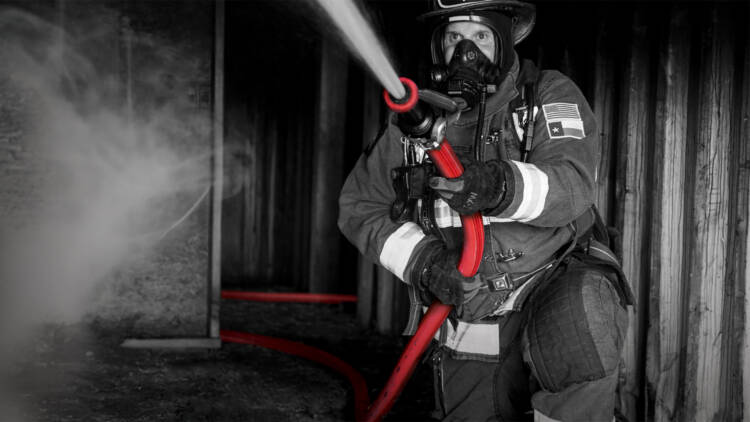
Rather than stiffening the entire hose, patent-pending LPX Technology reinforces only the critical section nearest the nozzle, where control matters most. This targeted reinforcement improves hose structure under low-pressure operation, reducing whip and kinking while preserving the defining characteristics of modern small-diameter lines: light weight, flexibility, and packability.
Kevin Moul, vice president of The Fire Store, describes the intent clearly: “The idea is to keep the nozzle forward and out in front of you—stiff where it needs to be, flexible where it doesn’t. We’re only reinforcing the last few feet because that’s what actually matters.”
Integrated into Mercedes’ small-diameter EXO lines—including the KrakenEXO® LPX 1½-inch and ExoMetro® LPX 1¾-inch—LPX allows firefighters to operate low-pressure smooth bore packages with improved confidence and control at the nozzle.
FROM FIREGROUND PERSPECTIVE TO ENGINEERED PURPOSE
Early hands-on evaluations of LPX lines saw meaningful improvements in stability and handling during interior advancement. Caleb Langer, who acted as a consultant during testing, confirmed, “As the nozzle firefighter, the KrakenEXO LPX 1½-inch handled well. We were able to utilize a low-pressure 50-psi nozzle flowing 160 gpm and still use traditional techniques—and map water throughout the fire area effectively.”
Chief David Stone of South Walton Fire District, Santa Rosa Beach, Florida, tested flows between 130 and 150 gpm and echoed that assessment: “The Mercedes KrakenEXO LPX 1½-inch hose presented as a more stable and rigid product. The improved bite-end control and reduced nozzle whip were clear advantages during the evaluation.”
These observations reinforce LPX’s intent—not to change tactics but to remove a mechanical limitation that has long restricted the practical use of smaller-diameter handlines. LPX was engineered to solve that exact problem in the most efficient way possible.
“AS THE FIRST LINE GOES, SO GOES THE FIRE”
The legacy of Andy “Nozzles” remains strong in 2026. He pushed the fire service to adapt while honoring its tradition and mission. The modern 1½-inch handline is not a step backward for “the firefighter and his nozzle.” It is the result of deliberate, research-driven refinement—building on proven practices while aligning with today’s operational realities. When paired appropriately, it offers a compelling balance of flow capability, maneuverability, and reduced firefighter fatigue.
In a fire service increasingly defined by precision, targeted innovation matters. The most meaningful advances are not about doing more everywhere but about doing exactly what is needed, exactly where it counts. With new technology like LPX, modern 1½-inch handlines become a viable option for departments looking to improve fire attack in the face of low staffing and give crews an advantage in those initial minutes on the fireground.
After all, as Fredericks preached, “A well-placed hoseline saves more lives than any other tool in firefighting.” And THAT will always be the mission.
LPX™ Technology will officially launch at FDIC International 2026 at Mercedes Textiles’ booth 4269. The new lines will be available to flow outside at booth 16521, providing a hands-on opportunity to see how precision engineering can translate into precision fire attack on the modern fireground.