
written by Capt. Jordan Hempker
THIS IS PART 1 of 3 IN THE (RE)DIAL IT IN SERIES: TRIGGER 1 | TRIGGER 2 | TRIGGER 3
In this series, we're focusing specifically on the need to reevaluate one of the most critical systems an organization builds: its hose and nozzle attack package. Too often, departments select a hose and nozzle configuration, flow it once to obtain pump discharge pressures, commit those numbers to memory, and never revisit the training for years—if ever.
In part one, we looked at the first re-evaluation trigger: when you get new hose.
For Trigger #2, we discussed using onboarding new shift members as a perfect opportunity to review your packages and pressures.
Here we've got the last scenario... Because knowing exactly what we are doing as the engine company arriving on scene matters. The first line makes the difference.
Trigger #3: When Something Feels Wrong
When an engine company is truly dialed in—pressure, flow, feel, and maneuverability—the handline becomes second nature. That is the mark of a well-designed system and in-tune firefighters.
Because the system is familiar, abnormalities stand out immediately.
I often compare it to your personal vehicle. You drive it every day. The moment you feel a vibration or hear a new noise, you notice it. You may not know the exact cause yet—but you know something isn’t right.
The same applies to our apparatus and hose systems. When something feels off, red flags should immediately go up.
Common indicators include:
The line feels uncontrollable — is it over-pumped or under-pumped?
Stream quality is poor — is there an internal hose issue or nozzle damage?
Excessive vibration at the nozzle
Increased noise while flowing
Pump sounds or vibrations that seem abnormal
Gauges that don’t match expected pressures
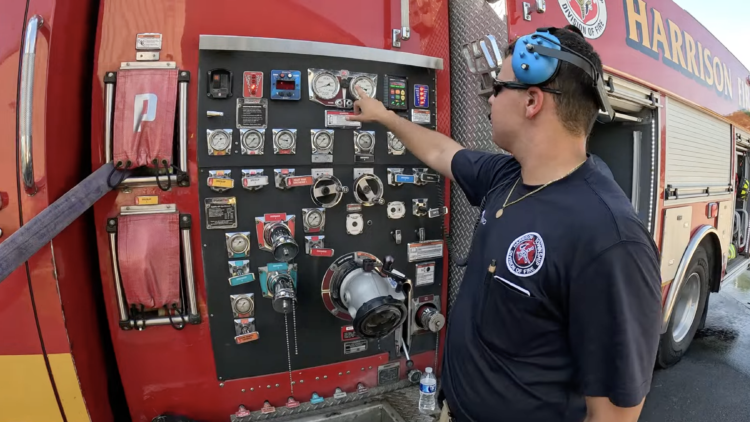
Increased workload at the pump panel
Equipment swapped from a reserve engine
Recent extreme weather that could have damaged components
Suspected hose delamination from previous fires
When these signs appear, it is the crew’s responsibility to begin systematic troubleshooting.
Sometimes the solution is simple.
Sometimes it requires taking equipment out of service.
Sometimes it’s the call: “Chief, can you come take a look at this?”
But it always begins with recognizing the abnormality.
Start With the Baseline
This is where your pump chart becomes invaluable. Every department should verify their master PDP to each individual gauge PDP to have a starting point for the loss due to truck plumbing.
From there, each individual line should be dialed in to confirm the pressure at the nozzle and the matching gauge PDP, accounting for friction loss in the hose.
Your pump chart represents your baseline—verified pressures, flows, and performance expectations. When something feels wrong, shut it down and start over.
Flow the line according to the chart.
If discrepancies appear, begin narrowing the cause:
Hose issue?
Nozzle issue?
Apparatus problem?
Gauge malfunction?
User error?
Guessing is not troubleshooting. Data is.
Use Simple Diagnostic Tools
Some of the most effective troubleshooting tools are:
Inline pressure gauges
Pitot gauge (for smooth bore nozzles)
Flow meter
A strong diagnostic setup includes:
One gauge at the discharge
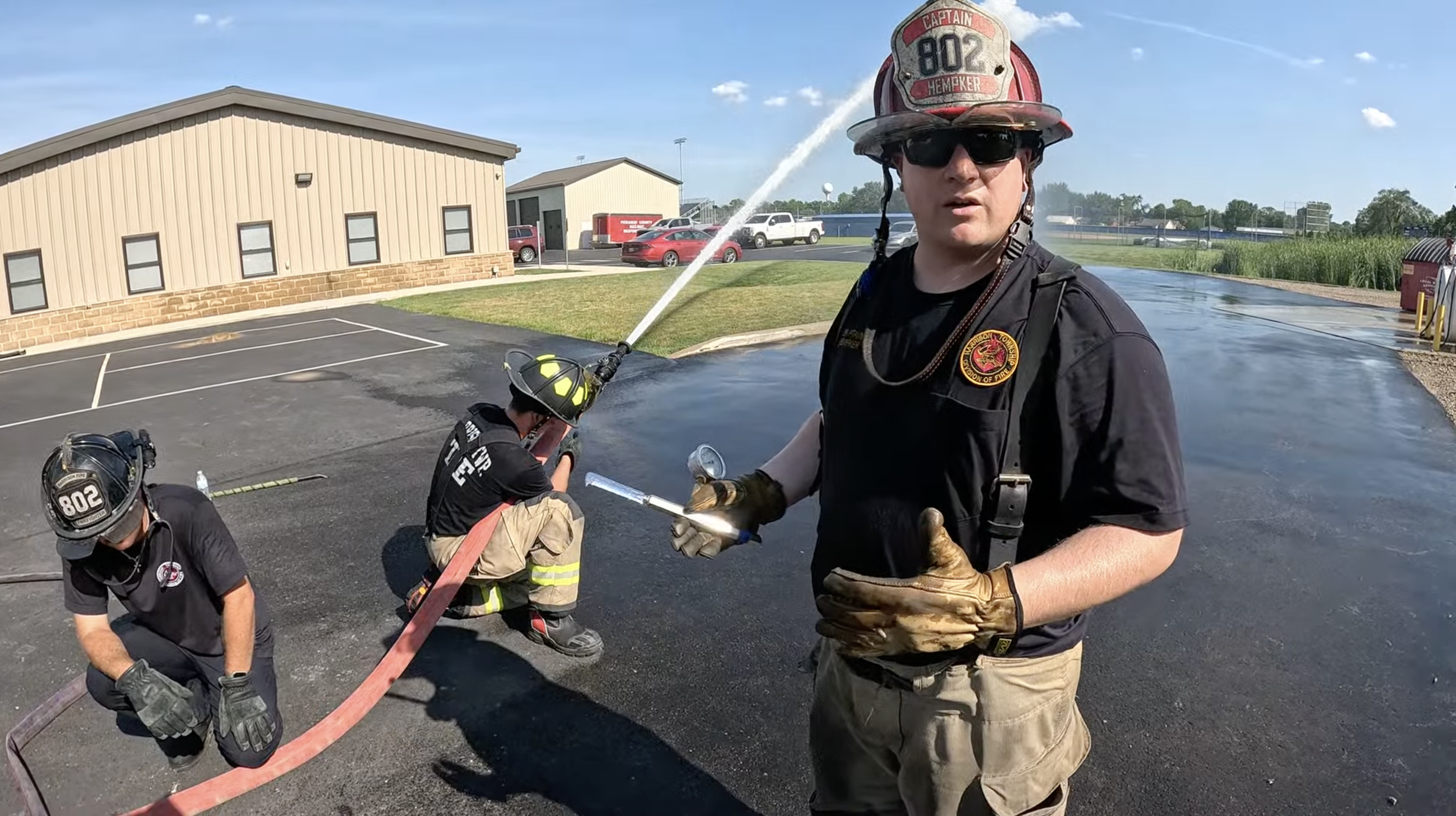
One inline gauge approximately 100 feet down the line
A pitot at the nozzle (if smooth bore)
Now you have multiple data points.
You can verify:
Pump gauge accuracy
Friction loss in the hose
True nozzle pressure
Actual gallons per minute
For example, if an attack line is designed to flow 160 GPM with a 7/8” tip, but your flow meter shows higher output, you may have an unintended valve open—such as tank fill—or an internal valve issue. These devices eliminate guesswork.
A Real-World Example: The Over-Pumped 2½”
During one of our rookie “Engine Day” trainings, we moved to our 2½” attack line:
200 ft
Smooth bore nozzle
Stacked tips: 1 1/8” and 1 1/4”
- Tested & confirmed flows:
265 GPM (1 1/8”) at 80 psi PDP (50 psi NP)
324 GPM (1 1/4”) at 90 psi PDP (50 psi NP)
We were flowing a single line. Immediately, something felt wrong.
The nozzle firefighter struggled with control. At first, I attributed it to the fact that this was a newer member. But experienced firefighters had the same difficulty.
The stream quality was poor:
Reduced reach
Early stream break-up
Excessive nozzle noise
The line did not perform the way it had during previous trainings. We checked the nozzle pressure with a pitot gauge. It read 60–64 psi – grossly over-pumped.
We shut everything down and went back to the pump chart. Following our chart and adjusting pressure while monitoring the pitot, we determined that the nozzle returned to 50 psi when the individual discharge gauge read 65 psi—not 80 psi as the chart indicated.
The issue? A faulty discharge gauge.
Here’s what was happening:
The master discharge gauge was set correctly at 80 psi.
The individual 2½” discharge gauge falsely displayed 65 psi.
Pump operators increased pressure until that gauge read 80 psi to match pump chart.
In reality, the line was being significantly over-pumped.
When flowing multiple lines, the problem became even more dangerous. With the master discharge at 110 psi for a 1¾” line, the 2½” had to be gated down—but because the gauge was inaccurate, it continued to be over-pumped.
We identified a situation where a large-caliber handline could have:
Injured firefighters
Reduced stream effectiveness
Created a false sense of proper pump operation
We notified the chiefs immediately, and all pump panel gauges were replaced.
A NOTE ON MASTER VS INDIVIDUAL PDP: In this scenario, we had previously tested & verified the individual gauge PDP having minimal to no loss from the master PDP. We had built our pump chart on the verified PDPs and flows – but the experience at the nozzle wasn't as expected. THE HOSE FLOW FEELING OFF IS THE TRIGGER, not just the fact our gauges weren't close.
Every department should build a verified pump chart for their panel. Individual gauge discrepancies will vary depending on truck plumbing. Individual PDPs will vary depending on the hose friction loss, length, and expected nozzle flow.
Train to be confident in how the hose SHOULD feel, then you can recognize when it is off and work to find the issue.
Why This Trigger Matters
The fire service places enormous strain on equipment. Engines go from cold bay status to high-demand pumping within minutes. Lines are deployed aggressively. Water is introduced rapidly. Pumps operate at peak performance without warm-up.
Over time, components fail. If your crew is not in tune with how a properly functioning attack line should feel, you may never catch those failures.
When something feels wrong, it probably is. That moment is not an inconvenience—it is a trigger.
A trigger to:
Shut down
Verify
Diagnose
Correct
Final Thoughts – Don't set it & forget it
Hose and nozzle packages are not “set it and forget it” systems. They are high-demand operational tools that must perform under extreme conditions. Components wear. Gauges fail. Hose degrades. Nozzles change. Apparatus gets modified. Personnel turns over.
It is not enough to flow a line once, write down a pressure, and never revisit it. It’s critical to test your systems over time and verify your numbers to ensure your pump panel is accurate and your attack lines are delivering what you believe they are.
Without verification, you’re operating on assumption. With verification, you’re operating with confidence.
Flow it. Measure it. Validate it. Because the first line makes the difference.
About the Author:
Captain Jordan Hempker is an 18-year fire service veteran with experience in rural and suburban operations. He currently serves as a shift commander with Harrison Township Fire Department in central Ohio, where he focuses on adapting engine company tactics for limited staffing and diverse incidents. His approach emphasizes tactical clarity, aggressive operations, and leadership that meets today’s fireground challenges.
Jordan began his career as a volunteer firefighter, proudly serving for 10 years while gaining valuable experience across multiple part-time departments. He later served full-time with Shawnee Township Fire Department and American Township Fire Department, both located in Lima, Ohio.
He owns and operates Western Buckeye Training, a fire service training company focused on modern, mission-driven operations. In addition, Jordan is a consultant for Mercedes Textiles, contributing to training and education on fire hose and attack packages across North America. Jordan is married to his wife, Brittany, and they share their home with three dogs. He also takes great pride in being an uncle.